What began as a handful of machine learning models managed by specialized data science teams has rapidly evolved into a sprawling ecosystem of generative AI applications, embedded AI capabilities, autonomous agents, and third-party services.
AI is no longer confined to research labs or innovation teams; it’s part of and relied on by everyday business operations, with employees across every function building, buying, and using AI to improve productivity and accelerate decision-making.
This shift is now an opportunity. Organizations are using AI to streamline operations, improve customer experiences, and unlock value at a pace that would have been difficult to imagine only a few years ago.
But there’s a cause and effect: AI has become significantly more difficult to govern. Business users can create AI-powered workflows without writing code. Software vendors are building AI into existing platforms. Agents are beginning to execute multi-step tasks with increasing levels of autonomy. Models are updated continuously, regulations continue to evolve, and new use cases emerge almost daily.
Key Takeaways
- AI adoption has expanded beyond traditional machine learning to include generative AI, embedded AI, autonomous agents, and business-led AI development.
- Traditional governance approaches were not designed to keep pace with the speed, scale, and continuous evolution of modern AI systems.
- AI governance is evolving from a periodic compliance activity into an operational capability embedded throughout the AI lifecycle.
- Modern AI governance platforms provide centralized visibility, operational workflows, and continuous assurance that help organizations scale AI responsibly.
- Organizations that operationalize AI governance can innovate faster while strengthening trust, accountability, and regulatory readiness.
The challenge facing executive teams is no longer whether they should adopt AI. That decision has largely been made. The question now is whether their governance capabilities have evolved quickly enough to keep pace with the technology itself.
For many organizations, the answer is no.
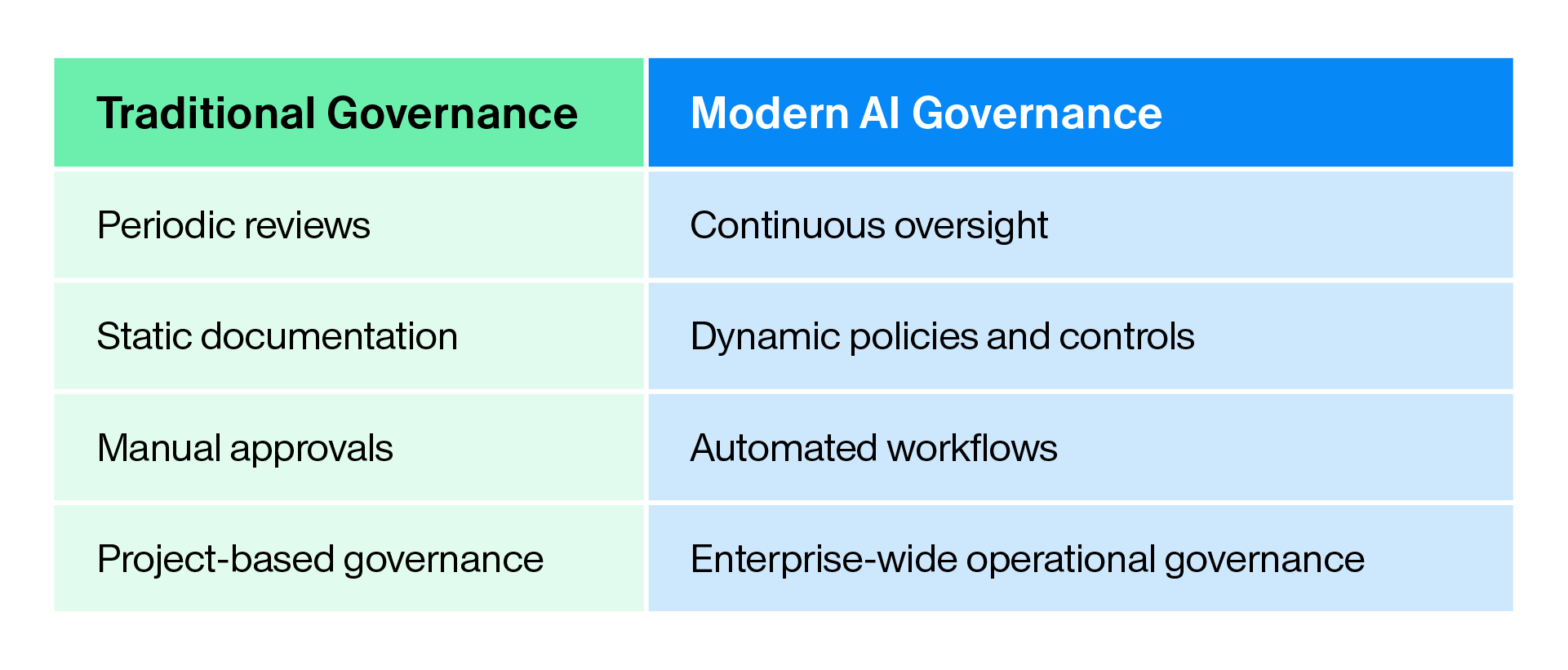
The governance models that have served enterprises well for decades were designed for slower-moving technologies with predictable development lifecycles. AI has fundamentally changed those assumptions. As organizations move from isolated AI projects to enterprise-wide AI adoption, governance must evolve from a periodic oversight function into an operational capability that enables innovation while maintaining trust, accountability, and control.
AI Has Outgrown Traditional Governance
Only a few years ago, governing AI primarily meant reviewing internally developed machine learning models before they entered production. Those models were typically built by centralized teams following structured development processes. Governance focused on documentation, validation, and periodic reviews that aligned well with established risk management practices.
Today's reality looks dramatically different.
AI touches more systems, suppliers, and business processes than governance programs were designed for. Employees interact with embedded AI features inside software they already use every day. Autonomous agents are beginning to make decisions, coordinate activities, and execute business processes with limited human intervention.
In many organizations, AI adoption has become decentralized. Instead of a single team driving implementation, AI initiatives now originate across legal, marketing, HR, finance, customer support, engineering, procurement, and virtually every other business function.
This democratization of AI is one of the technology's greatest strengths. It allows organizations to move faster, empowers employees to solve business problems directly, and accelerates digital transformation. But it also introduces new governance challenges. Organizations must understand what AI is being used, how it works, and what rules apply. Without that visibility, governance becomes reactive instead of proactive.
Existing Governance Models Are Reaching Their Limits
Most enterprises are not starting from scratch. They have functions that oversee technology, risk, compliance, privacy, and security. These remain essential, but they were not designed to govern the speed, scale, and complexity of modern AI.
In Financial Services, model risk management has traditionally focused on validating predictive models before deployment and proving their compliance. Governance, risk, and compliance programs excel at documenting policies, assigning controls, and demonstrating regulatory compliance. Security teams protect infrastructure, while privacy teams oversee responsible data use. Each discipline addresses an important piece of the puzzle.
The challenge is that AI cuts across all of them simultaneously.
A single agent may introduce privacy concerns, cybersecurity risks, intellectual property considerations, third-party vendor dependencies, regulatory obligations, and evolving model behavior—all while being deployed and updated continuously. Managing these interconnected risks through disconnected governance processes often results in duplicated effort, inconsistent decisions, and slower innovation.
Many organizations also continue to rely on manual governance processes that simply cannot scale. AI inventories maintained in spreadsheets quickly become outdated. Approval workflows conducted through email create inconsistent documentation and limited visibility. Risk assessments performed only during initial deployment provide little insight into how AI systems behave months later after prompts have changed, models have been updated, or new data sources have been introduced.
The issue is not that these governance practices are ineffective. They were just built for a different operating environment.