Artificial intelligence is a permanent part of the enterprise technology stack. Employees are using generative AI to increase productivity, vendors are building AI into existing products, and organizations are exploring increasingly autonomous systems that can take action on behalf of users. As AI adoption accelerates, security leaders face a new challenge: governing AI at the same pace it’s being deployed.
The conversation has evolved beyond how AI can help detect threats or automate security operations. Today's challenge is understanding where AI exists across the organization, what data it accesses, how it influences decisions, and what controls are needed to manage risk. AI governance has become a core security responsibility.
Organizations that succeed in the next phase of AI adoption will move beyond policy documents and manual reviews. They will embed governance directly into workflows, systems, and decision-making processes. This shift toward governance by design allows organizations to scale AI innovation while maintaining visibility, accountability, and control.
Key Takeaways From the Blog
- AI governance has become a critical security and business priority.
- Organizations need a complete inventory of AI systems, models, and vendors operating across the enterprise.
- Structured AI intake and review processes help balance innovation with risk management.
- AI governance should extend throughout the technology lifecycle through continuous monitoring and oversight.
- Agentic AI introduces new governance challenges that require runtime controls and observability.
- Governance should enable AI adoption, not slow it down.
Why AI Governance Has Become a Security Priority
The security conversation around AI has changed dramatically over the last two years.
Early discussions focused on productivity gains and individual use cases. Today, security leaders are asking broader questions. What AI systems exist across the organization? What data is being shared with those systems? Which vendors are using AI on the organization's behalf? How are AI-generated outputs influencing business decisions? Most importantly, how can organizations manage risk at scale?
These questions are becoming increasingly difficult to answer as AI spreads throughout the enterprise. AI capabilities are now embedded across customer service platforms, productivity suites, software development tools, security products, analytics systems, and third-party applications. In many cases, AI adoption is occurring faster than traditional governance processes can keep up.
At the same time, regulatory scrutiny is increasing. Organizations are expected to demonstrate accountability, transparency, and oversight across the AI lifecycle. Security teams are increasingly finding themselves at the center of these conversations because AI risk touches data protection, cyber resilience, third-party risk, compliance, and operational governance.
For many CISOs, AI governance is becoming as foundational as cloud governance was a decade ago.
Start With an AI Inventory
Before organizations can govern AI, they need visibility.
Many enterprises underestimate the number of AI systems operating across their environment. Beyond approved applications, AI capabilities are increasingly embedded within SaaS platforms, productivity tools, development environments, security technologies, customer-facing applications, and third-party services. As a result, most organizations have significantly more AI exposure than they realize.
This visibility gap creates one of the most immediate governance challenges. Security and governance teams cannot assess risk, implement controls, or monitor usage if they do not know where AI exists.
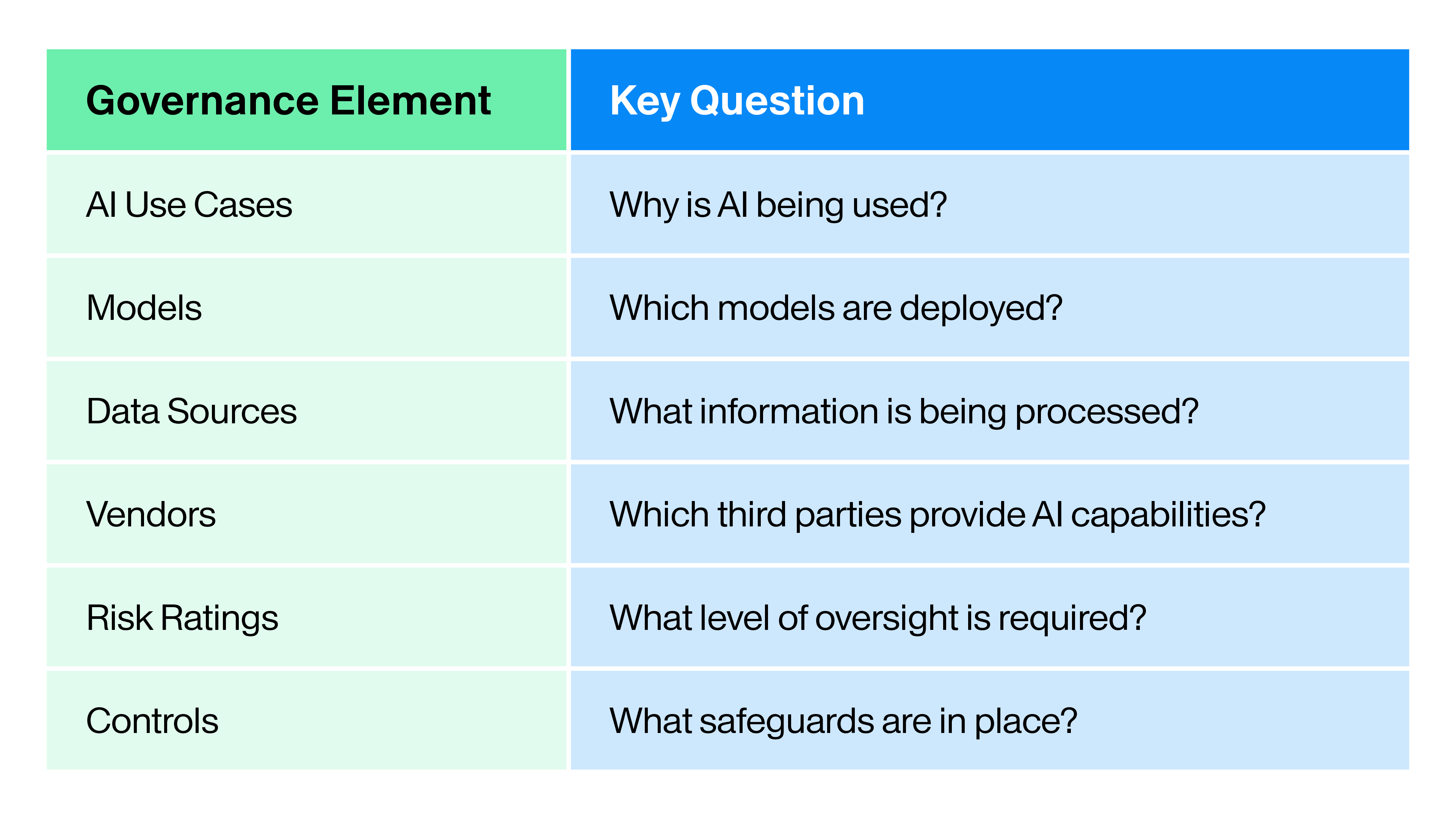
A centralized AI inventory serves as the foundation for governance. It provides a system of record that captures AI use cases, deployed models, data sources, vendors, business owners, risk classifications, and applicable controls.