AI Governance Capability

AI Policy Management
AI programs slow down when policies live in documents, standards live in separate systems, and review teams have to guess which controls apply to each use case. That creates inconsistent decisions, weak guardrails, and repeated policy debates. OneTrust AI policy management capabilities turn acceptable use rules, control requirements, and risk logic into versioned policy objects tied to AI use cases, systems, and regulations. Teams can define policy once, map it to risk classes and jurisdictions, and apply it through review, validation, reporting, and connected enforcement.
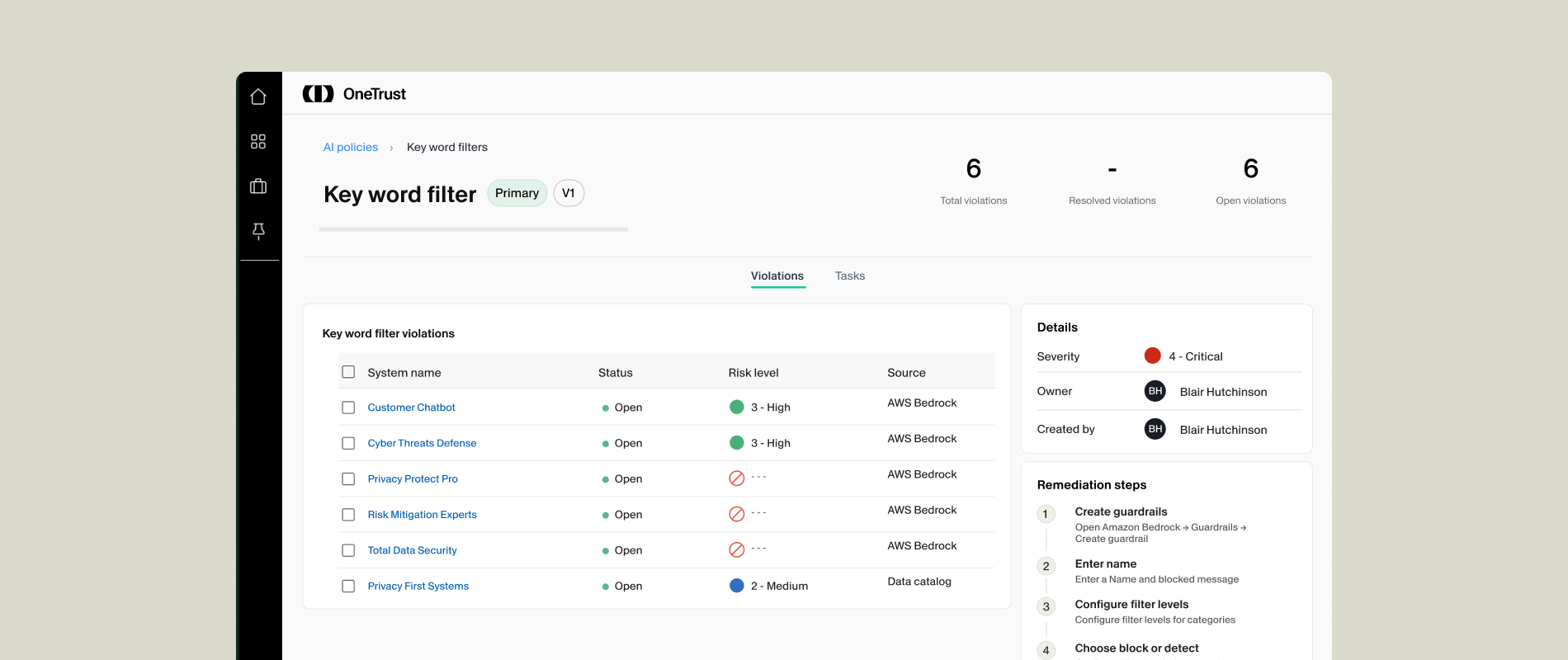
Build the Policy Layer Behind AI Guardrails
OneTrust AI policy management capabilities transform AI policies from static documents into versioned policy objects with defined scope, control requirements, and a managed lifecycle. Each policy object records which systems and use cases it governs, which controls it requires, what exceptions have been granted, and what changed between versions. Teams can define, apply, and maintain those policy objects through review, validation, exception handling, and revalidation — tied to specific use cases and systems throughout their lifecycle.
Turn Acceptable Use Policy Into Operational Policy
Most organizations start with broad AI principles such as fairness, accountability, transparency, security, and human oversight. Those principles matter, but they do not answer operational questions such as: can this use case process sensitive data, can this model be used in a customer-facing workflow, and what review path applies if human oversight is limited?
Acceptable use rules are structured as four named policy constructs:
- Policy Statements: Scoped rules organized by topic — data handling, model use, restricted use cases, human review, or third-party AI — that define what is permitted, restricted, or prohibited for a given system or use case.
- Applicability Conditions: Logic attached to each statement that determines when the rule applies, based on risk level, geography, data sensitivity, or deployment type. A statement about human oversight requirements, for example, can be configured to apply only to customer-facing systems above a defined risk tier.
- Control Requirements: The evidence and validation steps a statement demands before a system can be approved. These are checked during review and tracked for revalidation after material changes.
- Exception Records: A structured deviation process — capturing the policy rule, reason, compensating controls, approving authority, expiration date, and closeout criteria — for when a system cannot meet a control requirement as written..
That structure turns policy language into something the platform can apply, track, and audit consistently across use cases.
Map Policy to Risk Tiers, Frameworks, and Regulation
AI policy has to reflect internal rules and external obligations at the same time. A policy set may require human review for employment-related AI, added validation for generative AI using confidential data, or restricted deployment for systems that meet a high-risk threshold under the EU AI Act.
OneTrust maps policy to risk classification and framework obligations so a low-risk internal assistant and a customer-facing decision support system are not reviewed against the same policy logic.
Validate Controls Before and After Deployment
A policy only matters if teams can confirm that required controls are present. Before deployment, reviewers should be able to check ownership, approved data sources, human review requirements, restricted prompt patterns, model documentation, and relevant third-party review steps.
Control validation also has to continue after deployment. A model change, grounding change, new output action, or new deployment context can invalidate an earlier approval. Policy management should track which controls were required, which remain active, and which need revalidation after a material change.
This is where policy management differs from runtime controls. Runtime controls carry out the technical action in production. Policy management defines what should be enforced, which systems it applies to, and what evidence supports that decision.
Manage Exceptions, Remediation, and Policy Change
Policy sets do not stay static. New regulations emerge, AI use changes, and audit findings expose gaps. Teams need a process for exceptions and policy updates, not just a place to store current rules. A structured exception record should capture the policy rule, reason for the exception, compensating controls, approving authority, expiration date, and closeout criteria. Without that structure, exceptions become hidden precedent and review quality drops over time.
OneTrust ties policy exceptions to named use cases, systems, and owners so teams can see where policy friction is recurring and whether a rule, control, or workflow needs to change.
Distinguish AI Policy Management From Generic IT Compliance Tools
Traditional compliance tools help track evidence, issues, and control status. They do not define AI policy as an operational object tied to intended purpose, model behavior, human oversight, and AI-specific risk classes.
Gartner treats Policy Management and Enforcement as a distinct AI governance capability because organizations need more than control evidence. They need a defined policy layer that stays current as AI systems, use cases, and regulations change.
AI policy management gives organizations a clear way to define acceptable AI use, map it to risk and regulation, and connect it to enforcement and reporting. Explore how it fits into the full AI Governance solution.
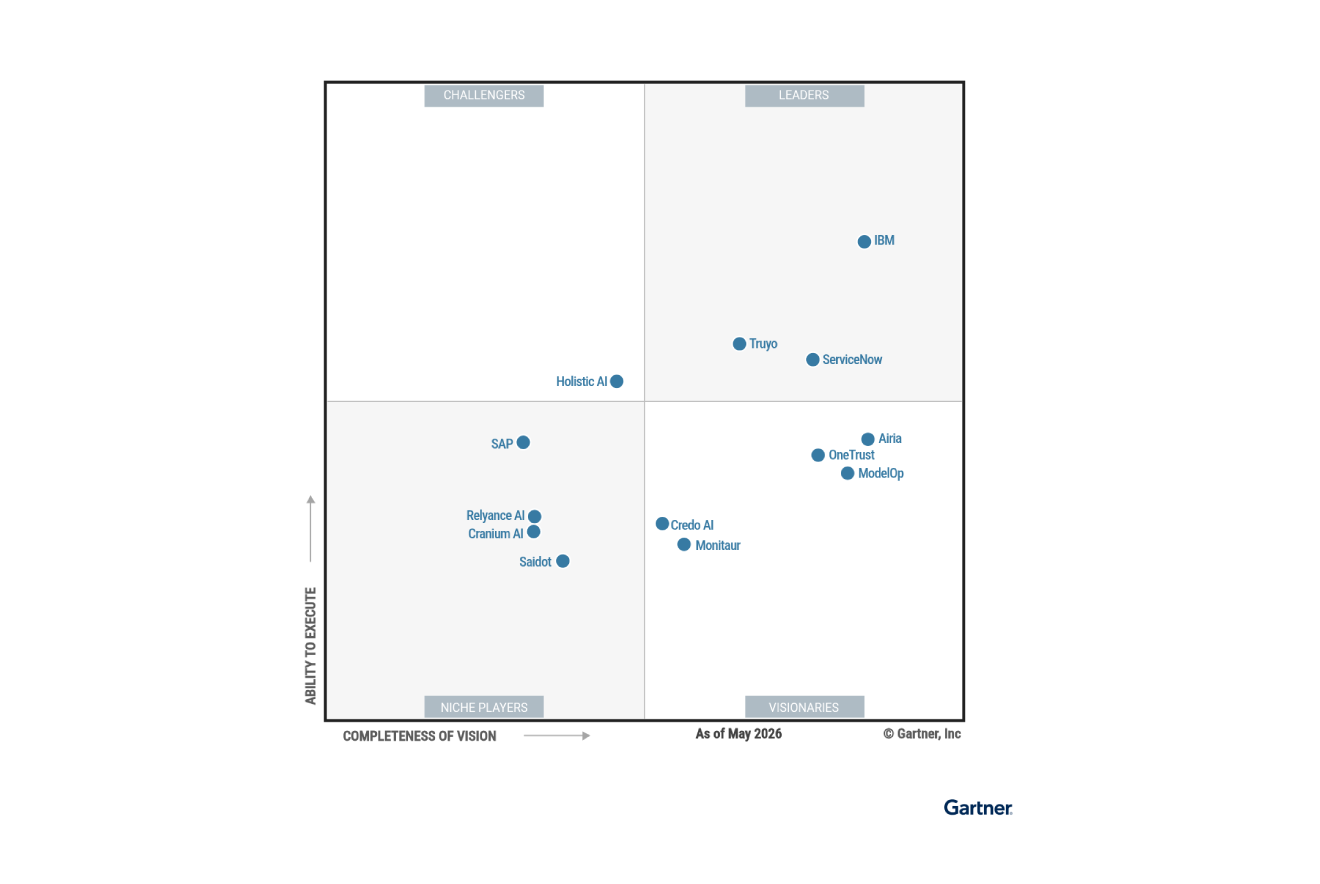
OneTrust Named a Visionary in the 2026 Gartner® Magic Quadrant™ for AI Governance Platforms
See why Gartner recognized OneTrust as a Visionary in the inaugural Magic Quadrant for AI Governance Platforms.
Frequently Asked Questions
OneTrust structures AI policy as named objects, not documents. Each policy object contains a policy statement scoped to a topic such as data handling, model use, or human oversight; applicability conditions that define when the rule applies based on risk tier, geography, or deployment type; control requirements that specify what evidence or validation steps the rule demands; and an exception record if the system cannot meet the control as written. Versioning is tracked at the object level, so teams can see exactly what the rule said at the time a system was approved and what changed afterward.
When a material change occurs — a model update, a new grounding source, an additional output action, or a new deployment context — OneTrust flags the affected policy objects and required controls for revalidation. The platform tracks which controls were satisfied at the time of the original approval, which remain active, and which need to be re-evidenced given the change. This means teams do not need to re-run a full review from scratch; they can scope revalidation to the controls the change actually affects.
OneTrust supports EU AI Act compliance by mapping internal AI policies to risk management, data governance, human oversight, and system quality requirements. Teams can link each policy statement to required controls, evidence, and review steps. That makes it easier to show how internal policy supports external obligations.
OneTrust aligns with frameworks like NIST AI RMF and ISO 42001 by turning policy into something teams can actually manage and use. Instead of tracking requirements in separate documents, it brings policies, controls, and accountability into one place. This gives policy owners a clear, governed way to define AI rules, connect them to controls, and show they’re being followed, making policy easier to manage and far more practical in day-to-day AI governance.
AI Policy Management defines the rule, scope, and required control. Runtime controls carry out the technical action in production, such as blocking, routing, redacting, or restricting behavior. One sets the policy logic. The other executes it. Both are needed, but they are not the same capability.
You May Also Like




Define AI policies once, map them to risk and regulation, and keep guardrails aligned as AI use changes.