On-demand webinar coming soon...


On-demand webinar coming soon...

Blog

OneTrust Debuts as a Visionary in the 2026 Gartner® Magic Quadrant™ for AI Governance Platforms

As AI adoption accelerates, organizations need new ways to understand risk, enforce controls, and govern at scale. Here's why we believe AI Governance is becoming a foundational business capability.


Sriram Iyer
Senior Vice President, AI Strategy & Products
June 22, 2026

photo of skyscrapers connected by skywalks. The viewer is looking up at the skyscrapers from ground level so that the blue sky can be seen between them.

Turning AI Risk into Enforceable Action Across the Lifecycle

Business teams are building, buying, and deploying AI capabilities faster than ever. Models, applications, agents, vendors, and business units are all contributing to an increasingly complex AI ecosystem.

While this acceleration is unlocking new opportunities for innovation and productivity, it's also exposing a growing challenge: organizations are adopting AI faster than they can govern its risks and ensure it delivers value.

As AI becomes more democratized and continuously evolves, governance can no longer operate as a periodic compliance exercise. Organizations need a way to continuously understand their AI estate, assess risk, coordinate decisions, and enforce controls at the speed of AI. 

That’s why we’re proud to be recognized as a Visionary in Gartner’s inaugural Magic Quadrant for AI Governance Platforms. 

As the first Magic Quadrant published for this category, we believe the report represents an important milestone in the evolution of AI governance and reflects its emergence as a foundational business capability.


What This Recognition Means

Effective AI governance requires three foundational capabilities: 

  • Continuous visibility into AI systems, models, agents, and data
  • Scalable governance processes that help organizations manage risk efficiently
  • Enforceable controls that turn governance decisions into action

We believe these capabilities are becoming increasingly important as organizations move from AI experimentation to enterprise-wide adoption. 

Gartner's recognition reinforces the value of a connected approach to AI governance that helps organizations translate AI risk into enforceable controls across the lifecycle.


Why AI Governance is Evolving

As AI adoption accelerates, governance must evolve from point-in-time reviews to continuous oversight, from documentation to enforcement, and from gatekeeping to enablement.

Traditional governance models were built for systems that changed relatively slowly. 

AI is different.

AI systems evolve continuously. New models are deployed weekly. Agents interact with enterprise systems autonomously. Data moves across increasingly distributed environments. Governance teams are being asked to manage more complexity with the same resources.

As a result, organizations are rethinking governance itself.

Rather than relying on point-in-time reviews, manual processes, and fragmented oversight, they're moving toward governance that's continuous, scalable, and embedded directly where data and AI operate. 

This shift is what we call AI-Ready Governance.

Recent OneTrust research highlights why organizations are rethinking governance today:

  • 73% say AI has exposed critical gaps in visibility, collaboration, and policy enforcement.
  • 75% say AI has exposed the limitations of legacy governance processes. 
  • 82% say AI risks are accelerating governance modernization efforts.

These findings reinforce what many organizations are already experiencing firsthand: governance must evolve from periodic oversight to continuous visibility, scalable governance processes, and enforceable controls.


A Connected Approach to AI Governance

The complexity of today's AI ecosystem requires more than point solutions or manual oversight.

A strong AI governance program begins with visibility.

Gartner's assessment highlighted OneTrust's capabilities in AI Discovery and Registry, recognizing the platform's ability to create a centralized inventory of AI systems, models, agents, and use cases. 

In many organizations, AI adoption happens across multiple teams and technologies, making comprehensive visibility difficult to achieve. A unified registry helps establish the foundation for governance by enabling organizations to understand the full scope of their AI estate.

However, visibility alone isn't enough.

AI systems are dynamic, and their risk profiles can change over time. Organizations need a way to continuously understand how changes to models, data, and use cases affect risk.

OneTrust's Dynamic Risk Scoring helps teams continuously assess AI systems based on evolving business, regulatory, and operational factors. 

Rather than treating governance as a point-in-time exercise, organizations need ongoing insight into how risk changes as models, data sources, and use cases evolve.


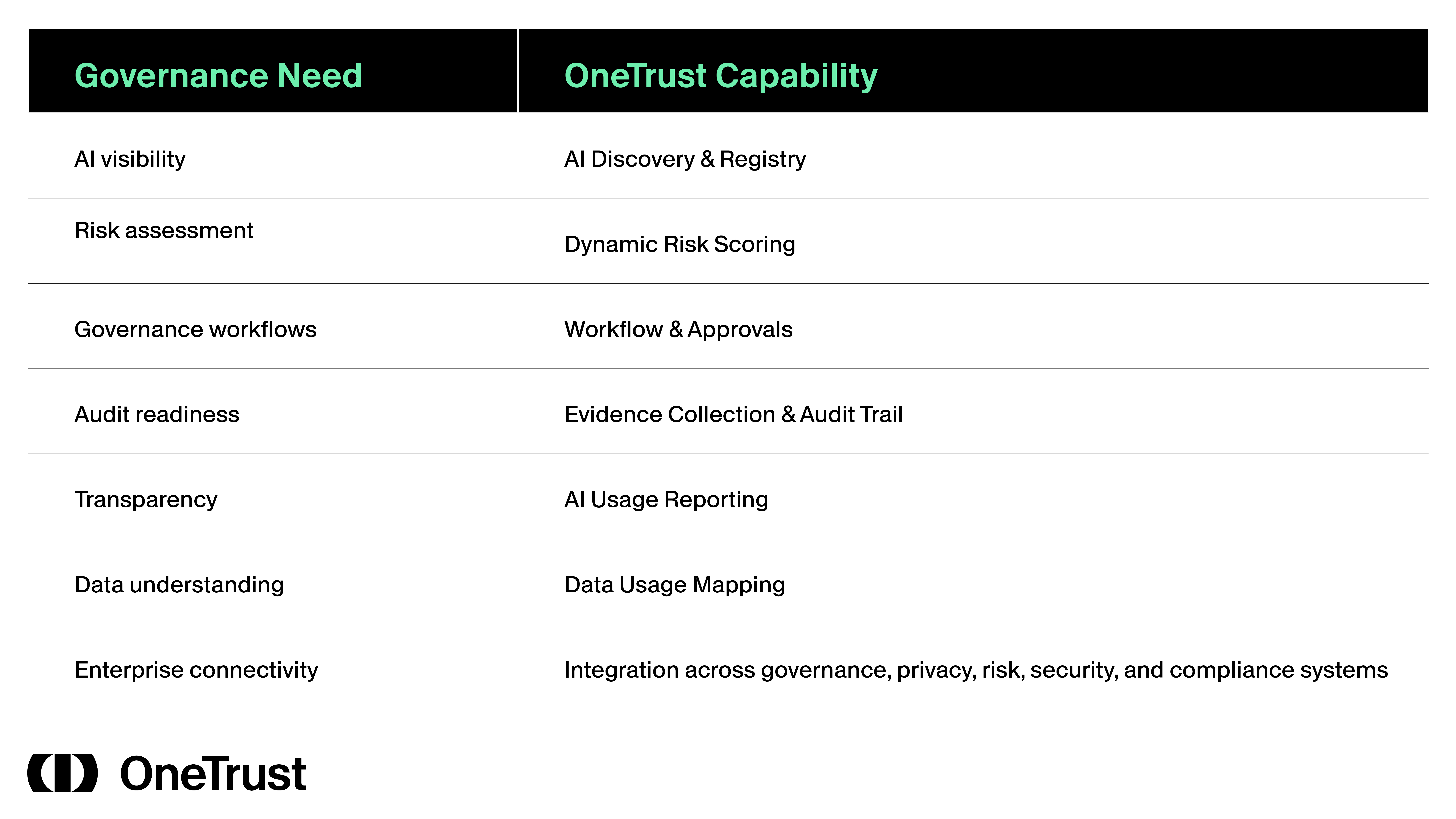
Key Capabilities for AI Governance

While every organization is at a different stage of AI adoption, most successful AI governance programs require a common set of capabilities:

Table describing the different needs for an AI governance program and the capabilities OneTrust brings to address them


Together, these capabilities help organizations move from understanding AI risk to actively governing it.


Turning Governance Into Action

Many organizations understand their AI risks but struggle to put governance decisions into practice.

Effective governance requires more than identifying risk. It requires a repeatable way to assess, review, approve, and manage AI systems as they move through the organization.

This is where governance workflows become critical.

OneTrust's Workflow and Approvals capabilities help organizations establish structured processes that support stakeholder collaboration, reviews, attestations, and approvals.

As AI initiatives scale, organizations need repeatable workflows that embed governance into existing operating models without creating unnecessary friction.

The ability to demonstrate governance is equally important.

Evidence Collection and Audit Trail capabilities help organizations maintain comprehensive records of AI-related decisions, testing activities, assessments, and remediation efforts.

Regulatory expectations continue to increase globally, and enterprises need reliable documentation that can support internal governance requirements, audits, and regulatory inquiries.

Together, these capabilities help organizations establish accountability while enabling teams to move forward with confidence.


Building Trust Through Visibility and Reporting

Trust in AI depends on transparency.

Business leaders, risk teams, compliance professionals, and regulators all need visibility into how AI systems are being used, how they're performing, and whether they're operating within established guardrails.

OneTrust's AI Usage Reporting and Data Usage Mapping capabilities help organizations gain that visibility across their AI programs.

Reporting helps organizations understand adoption trends, monitor AI activity, and communicate governance outcomes to stakeholders throughout the business.

Data usage mapping extends that visibility by helping organizations understand how data flows through AI systems, where it originates, and how it's being used.

These capabilities become increasingly important as enterprises navigate evolving regulatory requirements and seek to demonstrate responsible AI practices.


Governance Workflows That Drive Accountability

One of the strengths highlighted in Gartner's assessment was OneTrust's ability to support end-to-end governance workflows spanning intake, risk assessment, approvals, and runtime enforcement.

This is increasingly important as organizations move beyond documentation-based governance, because policies alone don't reduce risk.

Organizations need governance decisions to translate into measurable controls, repeatable processes, and enforceable outcomes.

By connecting governance activities across the AI lifecycle, organizations can move from isolated reviews to operationalized governance that scales with AI adoption.


Inventory and Runtime Controls Built for an Agent-First World

AI systems are becoming more autonomous, distributed, and interconnected.

As AI agents become embedded throughout business processes, governance must evolve beyond static reviews and periodic assessments.

Organizations need continuous visibility, ongoing monitoring, policy enforcement, and evidence generation — because this is where the market is heading.

Governance must move closer to where AI operates, enabling organizations to continuously understand, govern, and enforce policies across increasingly dynamic AI environments.


Enabling Governance Across the Enterprise

AI governance cannot exist in isolation.

It must connect with broader privacy, risk, security, compliance, and data governance programs.

AI governance works best when it connects with the systems teams already use every day. Organizations rely on diverse technology environments, and governance platforms must help teams share information, streamline processes, and create a consistent governance framework across the organization.

This becomes even more important as enterprises deploy AI agents and autonomous systems that operate across multiple platforms and business processes.


Governance Should Help Organizations Move Faster

For many organizations, governance has traditionally been viewed as a checkpoint that slows innovation.

AI changes that equation.

The organizations seeing the most success with AI are building governance directly into how AI is developed, deployed, and monitored. When teams have visibility into risk, clear decision-making processes, and controls that operate where AI is used, they can move forward with greater confidence.

Effective governance is no longer about saying "no." It is about helping organizations say "yes" safely, consistently, and at scale.

In other words, governance should not slow innovation. It should help enable it.


Looking Ahead

AI will define the next decade of business. Governance will help determine who succeeds.

The launch of Gartner's first Magic Quadrant for AI Governance Platforms signals something larger than the arrival of a new technology category.

It signals that AI governance is becoming a strategic business capability.

As AI adoption accelerates, organizations need governance capabilities that provide visibility, accountability, operational efficiency, and measurable business value.

We believe OneTrust's recognition as a Visionary reflects the strength of a connected approach that helps organizations understand their AI estate, assess risk continuously, put governance decisions into practice, demonstrate compliance, and measure outcomes.

AI has changed how organizations operate. Governance must evolve from point-in-time reviews to continuous oversight, from documentation to enforcement, and from gatekeeping to enablement.

We believe AI-Ready Governance is the next evolution of governance: helping organizations move from periodic oversight to continuous visibility, scalable governance processes, and enforceable controls across AI and the broader technology ecosystem.


Frequently Asked Questions

 

An AI governance platform helps organizations discover, assess, monitor, and govern AI systems throughout their lifecycle. These platforms provide visibility into AI use, support risk management, enable compliance, and help organizations apply governance controls consistently.

As organizations deploy more AI systems, they face growing risks related to privacy, security, compliance, bias, transparency, and accountability. AI governance helps organizations manage those risks while enabling responsible innovation.

Organizations should look for capabilities such as:
 

  • AI discovery and inventory management
  • Risk assessment and scoring
  • Governance workflows and approvals
  • Audit trails and evidence collection
  • Reporting and visibility
  • Runtime controls and policy enforcement
  • Integration with broader governance and enterprise systems

OneTrust helps organizations discover and understand their AI estate, continuously assess risk, operationalize governance decisions, enforce controls, and demonstrate compliance across the AI lifecycle through the OneTrust AI-Ready Governance Platform™.

AI systems increasingly operate continuously and autonomously. Runtime controls help organizations monitor behavior, enforce policies, detect issues, and generate evidence while AI systems are actively operating.

Effective governance provides clarity, accountability, and guardrails that help organizations move faster with confidence. Rather than slowing AI initiatives, governance helps organizations safely scale AI adoption while maintaining trust and managing risk.


Disclaimer: Gartner®, Magic Quadrant™ for AI Governance Platforms, June 2026.

Gartner is a registered trademark and service mark, and Magic Quadrant is a registered trademark of Gartner, Inc. and/or its affiliates in the U.S. and internationally and are used herein with permission. All rights reserved.

Gartner does not endorse any vendor, product or service depicted in its research publications and does not advise technology users to select only those vendors with the highest ratings or other designation. Gartner research publications consist of the opinions of Gartner's Research & Advisory organization and should not be construed as statements of fact. Gartner disclaims all warranties, expressed or implied, with respect to this research, including any warranties of merchantability or fitness for a particular purpose.