AI Use Is Growing Faster Than Visibility
The scale of the challenge is becoming difficult to dismiss. More than two-thirds (69%) of organizations suspect or have evidence of employees using public AI services, while fewer than 10% of enterprises deploy dedicated AI usage controls (Gartner).
These gaps are not simply a matter of incomplete inventories. When an employee uses an unapproved AI service, security teams may not know what data was shared, which provider processed it, whether the service has been assessed, or whether the activity is consistent with internal policy. Security controls can help protect devices and networks, but they were not designed to provide a complete, AI-aware view of the systems, services, and usage patterns that make up the modern enterprise AI estate.
The risk is also expanding beyond public chatbots. AI is appearing across three connected layers:
- The tools employees access
- The protocols and integrations that connect AI to business data
- The runtime environments where agents can take actions
Visibility tends to decrease as organizations move down that stack, while the potential impact increases.
The result is a familiar security question with a new level of urgency: What AI is actually being used across the business — and what should we do about it?
Introducing OneTrust's Shadow AI Detection Integration With Cloudflare
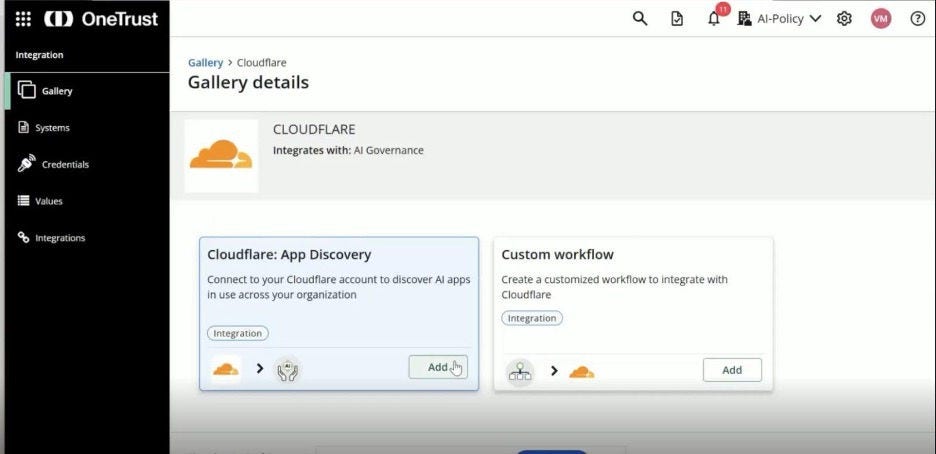
OneTrust is introducing an integration with Cloudflare’s Shadow AI detection to help answer that question with observed, network-level signals.
Cloudflare operates at a critical control point across network, gateway, and application traffic. Its AI activity signals can identify sanctioned and unsanctioned AI applications in use across the environment. OneTrust brings those signals into AI Governance, where they can be used to create or update the AI inventory and initiate governance workflows.
The integration is designed to reduce dependence on manual disclosure. Using the Cloudflare Detection Integration, organizations can connect their Cloudflare account, pull AI application activity, and surface discovered services in OneTrust. This creates a more scalable approach to mapping AI use combining what the business has declared with what the environment shows is happening. Instead of asking teams to investigate every signal from scratch, OneTrust can organize AI systems for review and connect discovery to assessments, ownership, regulatory alignment, and downstream action.
The result helps users understand the application and its usage while flagging services that have not been previously approved. It also gives security and governance teams a shared starting point: the same discovered AI service can be reviewed for risk, ownership, data handling, third-party exposure, and policy alignment.