AI Governance Capability

Runtime Controls
Your AI is already running in production. Models, copilots, and autonomous agents are acting across your environment faster than review cycles, intake forms, and static policies can keep up.
Runtime controls within OneTrust AI Governance close that enforcement gap. Continuous discovery keeps your AI inventory current, the AI Policy Engine turns written governance policies into machine-readable rules, and runtime observability helps trigger enforcement where risk occurs. Governance stops being a checkpoint teams wait on and becomes a control layer that runs alongside AI.
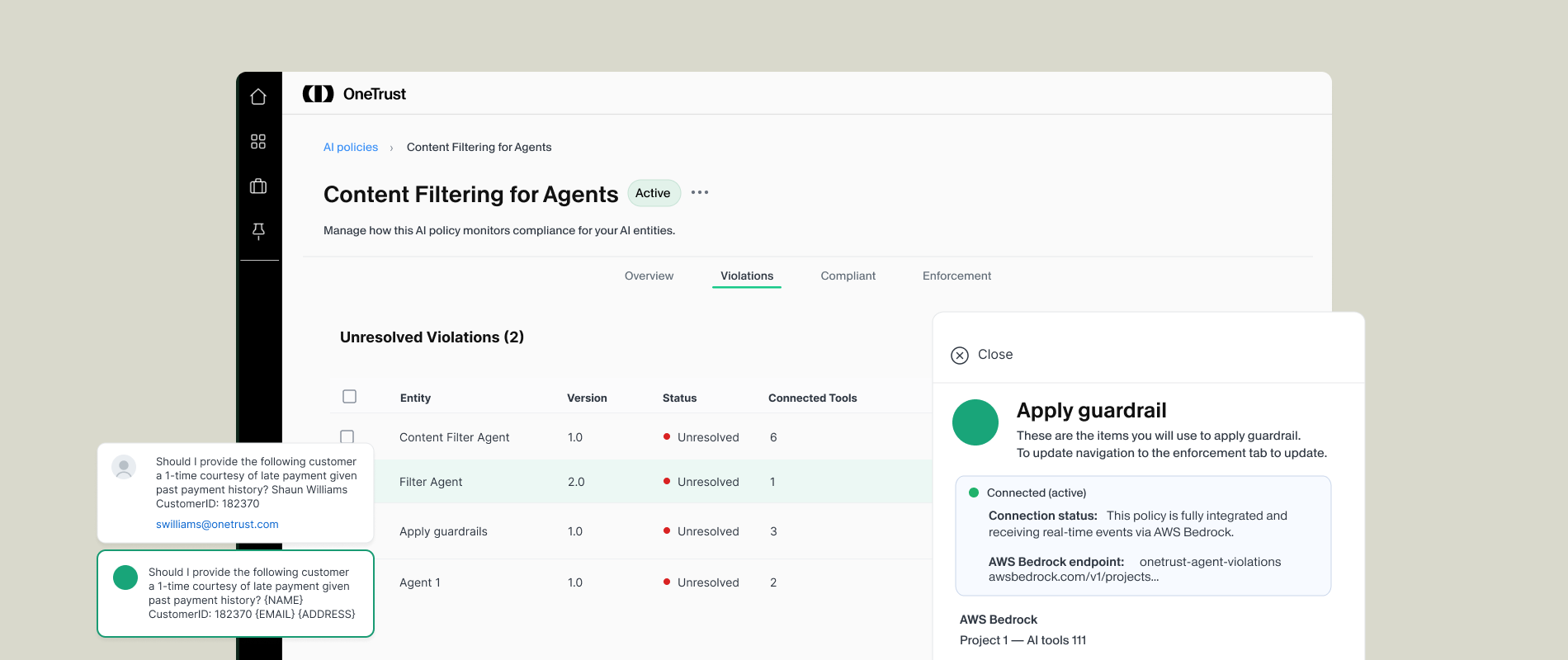
Continuous Runtime Control for AI in Production
OneTrust brings together live AI inventory, policy-based enforcement, runtime observability, and in-application controls to help organizations govern AI in production without slowing delivery.
Continuous AI Discovery and Live Inventory
Runtime control starts with visibility into what is actually deployed. OneTrust uses least-privileged access to discover AI assets across AWS, Azure, and GCP, then captures structured metadata in a centralized governance inventory.
The inventory is connected, not flat. OneTrust maps relationships across models, agents, datasets, and use cases so teams can understand where risk originates, how it propagates, and where controls need to apply.
Because discovery runs on a cadence you control, audits and risk reviews reflect current production reality instead of outdated intake records. Automated reconciliation also reduces manual inventory work, so governance teams can focus on decisions, not data collection.
Policy-As-Code Enforcement With the AI Policy Engine
Written policies do not enforce themselves. The OneTrust AI Policy Engine translates governance policies into machine-readable rules and enforceable controls, helping teams apply policy consistently across environments.
- Block or restrict access when a model requests a sensitive dataset
- Trigger a violation and route remediation when performance diverges across protected groups in a high-stakes use case
- Flag drift or behavioral changes in third-party models
- Escalate review when a system's usage or risk profile changes materially
Humans stay in the loop where judgment is required, but they spend less time identifying issues and more time responding to the right ones.
Runtime Observability With Telemetry-driven Monitoring
Inventory shows what exists. Telemetry shows what it is doing. OneTrust ingests runtime signals from the systems where AI runs to continuously monitor production behavior, surface emerging risk, and support policy enforcement in real time.
By connecting operational telemetry with governance context, organizations can detect drift, anomalies, safety issues, and policy violations earlier while generating the evidence needed for compliance, audit readiness, and stronger oversight.
- Continuously monitor models, agents, and AI runtime activity across production environments.
- Measure operational health through usage signals, token consumption, evaluations, and guardrail effectiveness.
- Detect sensitive data exposure and policy violations with log analysis and PII detection.
- Turn runtime activity into operational evidence for governance, compliance, and audit teams.
In-Application Controls With the AI Guard SDK
For teams that need controls embedded directly in application code, the OneTrust AI Guard SDK helps detect and control sensitive data flowing through AI systems in both prompts and model outputs.
With built-in actions such as allow, redact, and block, teams can add privacy controls closer to the point of use and reduce the risk of sensitive data exposure before it reaches end users.
AI Agent and Machine Identity Governance
Agents operate continuously through machine identities such as API keys, tokens, and service accounts, and their behavior can change as workflows evolve. OneTrust helps organizations discover deployed agents, keep inventory current as systems change, and monitor agent behavior in production.
Because OneTrust maps relationships across agents, models, data, and use cases, teams can attribute actions, contain blast radius, and strengthen accountability for AI-driven decisions.
Runtime Policy Enforcement Without the Governance Latency Tax
When risk occurs faster than governance can respond, organizations pay a governance latency tax. Review queues, ticket-based escalation, and periodic assessments slow delivery, leave risk windows open, and reduce the return on AI investments.
OneTrust helps eliminate that delay by combining predefined policy logic, live telemetry, and automated routing. The goal is not to remove humans from governance. It is to reduce the time between risk and response so governance can operate at the speed of AI.
OneTrust combines AI detection and inventory, a policy engine, in-application controls, and runtime signal ingestion into a unified enforcement layer for continuous AI governance across platforms.
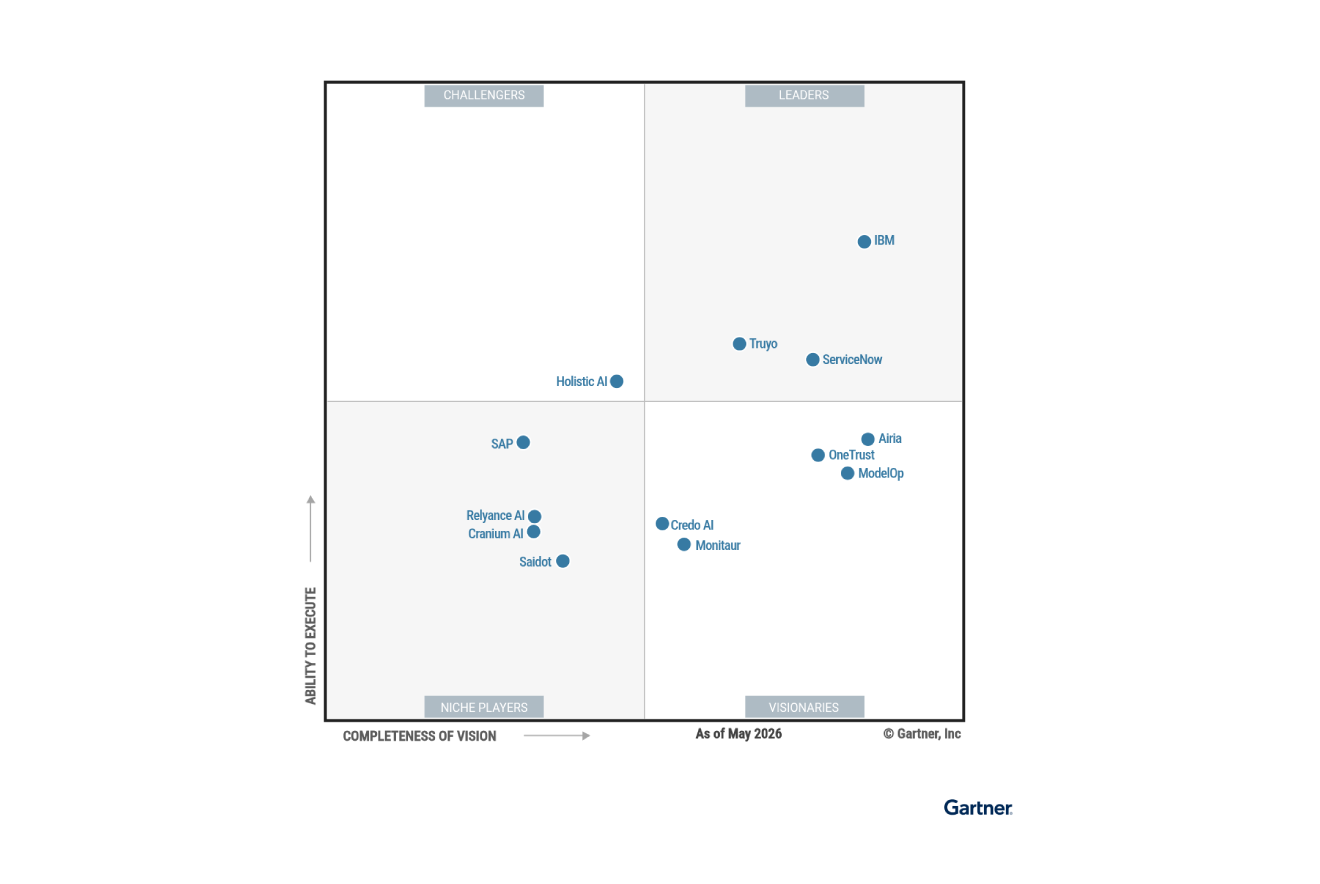
OneTrust Named a Visionary in the 2026 Gartner® Magic Quadrant™ for AI Governance Platforms
See why Gartner recognized OneTrust as a Visionary in the inaugural Magic Quadrant for AI Governance Platforms.
Frequently Asked Questions
OneTrust uses a policy-as-code approach. The AI Policy Engine turns written governance policies into machine-readable rules that can act against live telemetry where risk occurs, rather than waiting for manual review.
Depending on policy and risk context, OneTrust can block or restrict access, redact sensitive data through the AI Guard SDK, trigger escalation or re-review, and route violations to the right owner through automated workflows.
OneTrust combines cloud-based discovery with runtime observability. Discovery identifies deployed models, agents, and datasets, while telemetry ingestion monitors production behavior and informs governance decisions with live signals.
Yes. OneTrust helps organizations discover agents, map their relationships to models and data, monitor their runtime behavior, and trace actions back to their source.
The inventory is maintained through continuous discovery rather than manual intake. That helps ensure audits, risk reviews, and enforcement decisions reflect the current production environment.
You May Also Like




Extend Governance Into Execution