Databricks + OneTrust AI Governance Reference Architecture

Blog
OneTrust + Databricks: Programmatic AI Governance, Consent, and Regulatory Intelligence
Learn how OneTrust and Databricks help organizations enforce AI governance controls, activate consented data through Delta Sharing, and operationalize the Databricks AI Security Framework.
Sam Tawfik
Director of Tech Alliance Marketing
October 1, 2026

Organizations are bringing data, analytics, and AI together in Databricks. To scale responsibly, they need more than documented policies: they need policy-driven guardrails, controls across AI workflows, consent signals that travel with data, and a practical way to keep pace with regulatory change.
OneTrust and Databricks connect those requirements to the environment where data and AI are developed and used. OneTrust contributes AI Governance, Data Use Governance, Consent & Preference signals, and regulatory intelligence. Databricks provides the data intelligence platform and governance foundation. Together, they help teams move from governance intent to enforceable, measurable action.
How the Integration Works
- AI Governance and programmatic controls: Apply policy-driven guardrails across data, models, and agents, with monitoring and evidence for oversight.
- Consent Management and Delta Sharing: Deliver analysis-ready Consent & Preference data into Databricks without custom ETL.
- Regulatory intelligence and DASF: Translate changing requirements and the Databricks AI Security Framework into risk assessments, controls, ownership, and evidence.
Govern AI with Programmatic Controls
For Chief AI Officers, data leaders, and AI platform teams, the priority is scaling AI without creating governance friction. Policies and approvals must connect to the systems where AI is built, deployed, and monitored.
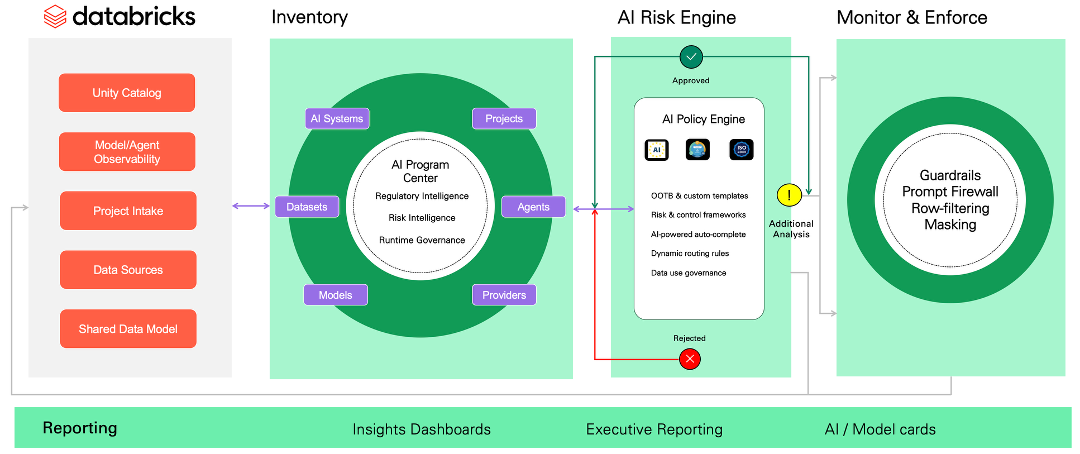
OneTrust AI Governance helps organizations inventory AI assets, assess risk, map frameworks and policies, manage lifecycle workflows, and continuously monitor AI posture. Its programmatic enforcement capabilities apply policy-driven guardrails across AI workflows, including runtime controls and policy-violation detection. Teams can define policy-driven controls across data, models, and agents and connect governance decisions to enforcement mechanisms within governed AI and data workflows.
OneTrust can also continuously retrieve Native Evaluation Metrics from Databricks, helping AI Governance teams evaluate model effectiveness, compare performance with historical trends, and maintain audit-ready evidence.
OneTrust Data Use Governance connects policy decisions to how data is accessed, shared, and used within analytics and AI workflows. That context can connect governance decisions to controls applied through Databricks Unity Catalog and related data workflows.
Databricks provides the platform where teams develop and operate data and AI workloads, along with Unity Catalog capabilities for access, discovery, lineage, and data protection. Together, OneTrust and Databricks connect AI risk decisions, programmatic controls, and evidence of model performance to the governed environment where data and AI are used, helping customers enforce controls consistently, improve accountability, and scale AI with confidence.
Activate Consented First-Party Data With Delta Sharing
Marketing and AI leaders want to use first-party data for personalization while honoring individual choices. Consent must inform downstream activation, analytics, and AI processing, not remain a record captured at collection.
OneTrust Consent & Preferences captures and manages consent signals. Through a zero-copy Delta Sharing integration, OneTrust can deliver decrypted, analysis-ready Consent & Preference data views directly into Databricks workspaces without custom ETL. Teams can use those signals for segmentation, activation, measurement, and approved AI-processing workflows.
Databricks provides a scalable environment for storing, analyzing, and activating first-party data, while Unity Catalog supports governed access and use. OneTrust contributes the consent and policy context that makes activation more responsible and explainable. The joint solution supports privacy-first personalization while giving privacy teams stronger evidence that data use aligns with permissions.
Connect Regulations to the Databricks AI Security Framework
For privacy, risk, and compliance leaders, the challenge is turning changing requirements into actions that AI and data teams can execute. The Databricks AI Security Framework provides an important security and governance foundation; organizations also need a repeatable operating model to assess risk, assign accountability, and demonstrate control effectiveness.
OneTrust regulatory intelligence and AI Governance capabilities help teams map obligations and frameworks to assessments, policies, controls, owners, and evidence. Databricks provides the data intelligence platform and AI security context in which those requirements are applied. Together, they create a more direct path from regulatory change to operational action as AI adoption grows.
Build Trust Into Daily Operations
For Databricks customers, responsible data and AI use is an operating requirement, not a separate workstream. OneTrust and Databricks connect programmatic AI Governance, consent-aware data activation, and regulatory intelligence to the platform where data and AI decisions happen.
The result is a practical foundation for scaling innovation with stronger controls, better visibility, and greater confidence.
Frequently Asked Questions
OneTrust adds AI inventories, risk and control frameworks, policy-driven guardrails, monitoring, Data Use Governance, consent signals, and workflows for evidence and oversight.
OneTrust applies policy-driven guardrails across AI workflows and supports controls across data, models, and agents. Databricks provides the governed environment in which those workloads and data are developed and used.
OneTrust continuously retrieves Native Evaluation Metrics from Databricks so AI Governance teams can evaluate model effectiveness, compare performance with historical trends, and maintain audit-ready evidence.
Delta Sharing delivers analysis-ready Consent & Preference data from OneTrust to Databricks without custom ETL, enabling teams to use permission signals in approved activation, analytics, and AI workflows.
Learn more
- Programmatically Enforce AI Governance Controls
- Operationalizing the Databricks AI Security Framework with OneTrust
- Unlocking Trusted Data Use with OneTrust + Databricks Unity Catalog
- Achieve AI-Ready Data with Data Policy Enforcement
- Accelerating Responsible AI with Databricks and OneTrust AI Governance
- Marketing Intelligence Is Evolving — And Privacy Is Leading the Way