AI is moving quickly across every business function. New use cases are being tested, deployed, and expanded in months, sometimes weeks. At the same time, privacy expectations are increasing, regulatory updates continue to surface across regions, and oversight responsibilities grow more complex.
For many privacy teams, that growth creates tension. Programs remain accountable for global compliance, risk management, and consumer rights, yet resources do not expand at the same pace. Manual assessments, repetitive reviews, and fragmented tooling slow progress just as the business accelerates.
The OneTrust Winter ’26 release is designed to embed intelligence across the governance lifecycle so privacy leaders can reduce manual overhead, strengthen oversight, and help the business move forward with confidence.
From assessment fatigue to intelligent automation
Privacy programs cannot scale AI oversight and regulatory complexity using spreadsheets and email threads. Manual processes introduce delays, create inconsistent data, and exhaust already limited resources.
The Winter ’26 release introduces deeper automation across core privacy workflows, starting with AI Inventory Analysis and AI Evidence Analysis.
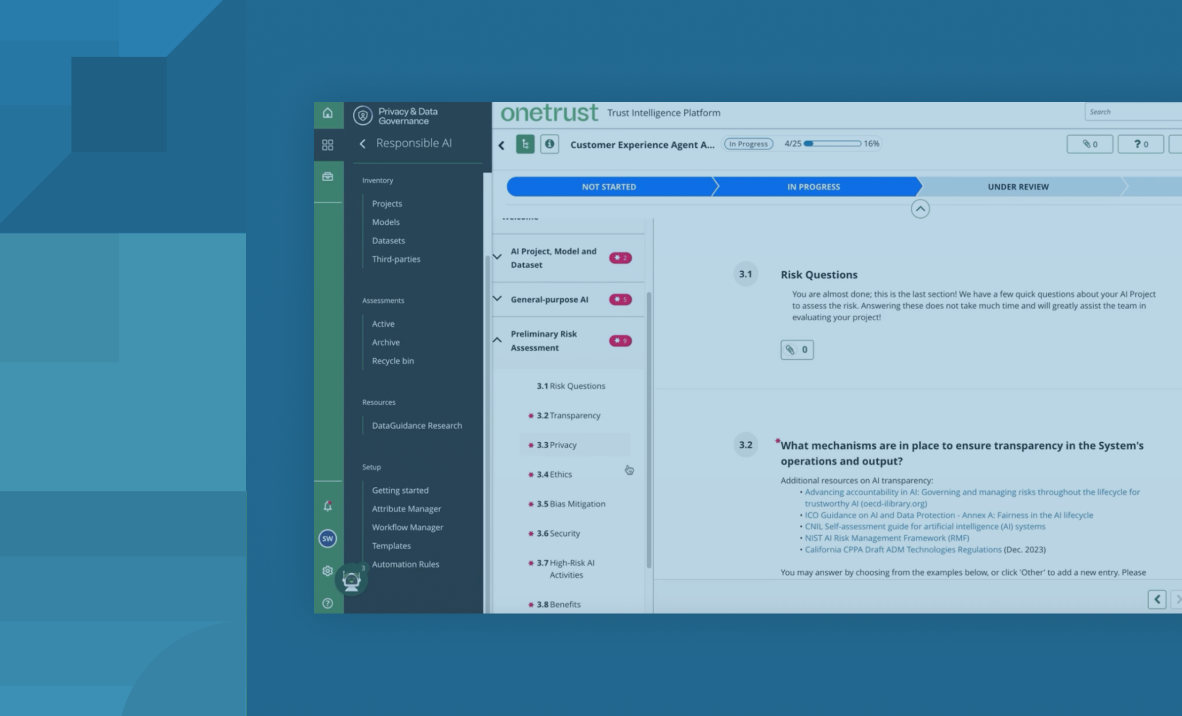
AI Inventory Analysis accelerates recurring risk assessments by analyzing prior evaluations tied to the same processing activities, assets, or vendors. It generates suggested responses for reassessments, clearly flagging AI-completed fields for review and validation. The result is faster completion, improved data quality, and a cleaner audit trail.
AI Evidence Analysis addresses another pressure point: manual evidence evaluation. It dynamically updates validation criteria based on system requirements (controls, legal basis, and stakeholder guidance or instructions), reviews evidence across formats (PDF, JPEG, Excel, or Text), and produces a clear summary and justification score, gap identification, and remediation guidance. Instead of chasing documentation across teams, privacy leaders can move from static reviews to structured, consistent validation.
For privacy teams managing manual PIAs, assessment fatigue, and constrained budgets, this shift matters. These enhancements enable privacy teams to better scale programs to business partners and stakeholders with proactive guidance. Within privacy workflows, teams can reduce repetitive work, shorten review cycles, and support a posture of continuous compliance rather than reactive remediation. Privacy automation becomes a friction reducer rather than another administrative layer.
Embedding governance where innovation happens
As AI initiatives expand into data platforms, governance cannot remain external. It must live inside the environments where models are developed, trained, and deployed.
The Databricks AI & Security Framework embeds governance guidance directly into AI workflows. This capability enables teams to scope initiatives to AI systems, automatically map controls to standards such as the EU AI Act, ISO 42001, and NIST AI RMF, and track compliance from a centralized program view.
This approach shifts oversight from periodic audits to ongoing monitoring. Guardrails are measurable and auditable, and controls align with global frameworks from the start.
For privacy professionals, this supports AI governance committee readiness and cross-functional alignment. It provides visibility beyond the legal requirements related to AI, and an operational view into how policies and controls are implemented across AI systems, agents, models, and datasets, helping privacy leaders contribute meaningfully to enterprise AI strategy. Instead of reacting after deployment, privacy can influence design decisions and ensure AI-ready data sets are governed appropriately from day one.
Responsible AI depends on embedded controls. When governance sits alongside innovation, the business can move quickly without compromising accountability.
Consent as a strategic asset
Consent has evolved from a regulatory checkbox into a foundational element of trusted data use. It shapes how customer data is activated, how personalization is delivered, and how AI models are trained.
This foundation goes further through Trust Center Enhancements, unifying consent, preferences, and privacy requests into a single, scalable experience. Instead of directing customers to fragmented portals, organizations can provide a clear and consistent interface where individuals can update preferences, manage consent, and exercise their data subject rights without friction.
For privacy teams working alongside marketing and data teams, consent becomes an operational bridge between privacy requirements and growth initiatives. The unified Trust Center supports compliance with consumer rights requirements and strengthens transparency obligations across jurisdictions. When consent systems are integrated across marketing and operational platforms, privacy leaders gain visibility into where personal data is in use and whether it is consented appropriately.
That connectivity reduces manual reconciliation between systems and enables more confident decision-making across channels. When consent data is governed consistently and shared across the organization, it informs AI training and analytics responsibly. In this way, consent becomes both a legal safeguard and an operational input for trusted growth.
Turning governance data into decisions
Privacy leaders need more than dashboards and static reports. They need insight into program performance, emerging risks, and areas that require attention.
OneTrust Copilot Analytics introduces conversational analytics over program data, allowing teams to ask questions in natural language and receive structured, contextual insights. Privacy leaders can identify trends, surface recommended actions, and generate reporting narratives backed by real program data.
This supports KPI tracking, regulatory readiness discussions, and board-level communication. Instead of assembling reports manually, CPOs can access up-to-date insights that reflect their actual privacy posture across risk assessments, AI inventories, and compliance workflows.
Governance data increasingly serves as the foundation for communicating progress and performance across the enterprise. When insights can be surfaced quickly and interpreted in context, privacy leaders can move beyond status updates and provide direction. Embedded intelligence accelerates that shift, helping privacy operate as a strategic contributor rather than a reporting function.
Closing AI blind spots before they scale
AI agents introduce new operational and compliance considerations. Without centralized visibility, it becomes difficult to understand which systems are active, how they interact with data, and what risks they introduce.
The OneTrust Winter ’26 release includes Agent Detection for AWS Bedrock, Azure Foundry, and Google Vertex, allowing organizations to discover AI agents across platforms and centralize related models, decisions, outputs, and risks within a searchable inventory.
This replaces reliance on periodic attestations with proactive monitoring. Governance teams gain visibility into distributed AI initiatives, helping them evaluate risk early and maintain oversight as deployments expand.
For privacy professionals, this addresses shadow AI risk, strengthens ecosystem oversight, and supports lifecycle governance across AI systems. Audit readiness improves when documentation, risk scoring, and compliance tags are continuously updated rather than reconstructed after the fact.
Visibility remains the foundation of responsible AI. When blind spots are reduced, governance can scale alongside innovation rather than lag behind it.
Building privacy for the AI era
Governance is becoming the intelligent infrastructure that powers innovation instead of slowing it down.
Through unified automation, embedded frameworks, modernized consent experiences, conversational analytics, and proactive AI agent discovery, Privacy Automation supports continuous innovation while maintaining accountability.
For privacy teams navigating regulatory complexity, AI acceleration, and resource constraints, this release reinforces a new operating model. Governance does not need to be a bottleneck. With the right intelligence in place, it becomes a durable foundation for responsible growth.
Explore the full OneTrust Winter ’26 release in our upcoming webinar and see how governance can move at the speed of innovation.
The capabilities covered here are a brief highlight of all the new advancements for privacy professionals. Access the full Winter ’26 Privacy Automation release to dive into how these enhancements fit together across the governance lifecycle.
What you need to know about the Winter ’26 Release